 Alex
Alex Est. reading time:
Read the 2026 interest rate forecast.
Save money on your mortgage
Don’t leave money on the table
Don’t just go with your bank
Get today’s best rates from our lenders
Key Takeaways
- Our current best fixed rate is 3.69% (vs 3.80% last month) and variable rate of 3.45% (Prime -1.00%, down 0.15% from last month).
- For first-time home buyers, listings remain elevated (especially for condos) in most major markets and will remain higher for the next few quarters. We still expect it will remain a buyer’s market until at least Q2 2026.
- For homeowners coming up for renewal, our Mortgage Renewal Calculator can help plan ahead to get a sense of what rate you can expect from your lender at renewal, what your new payment would look like and how Perch can help.
- For homeowners who would like to be automatically notified when there’s a benefit to switching lenders and breaking their mortgage early, Perch automatically calculates the net benefit on a weekly basis for all your existing properties. Make sure to sign up for your free profile today.
Mortgage Rates Prediction: Flat
For the month of March, we anticipate minimal movement in fixed rates and variable rates. Canada’s bond yields (which influence fixed mortgage rates) have decreased by roughly 0.20% in the last month (Source: Bank of Canada):
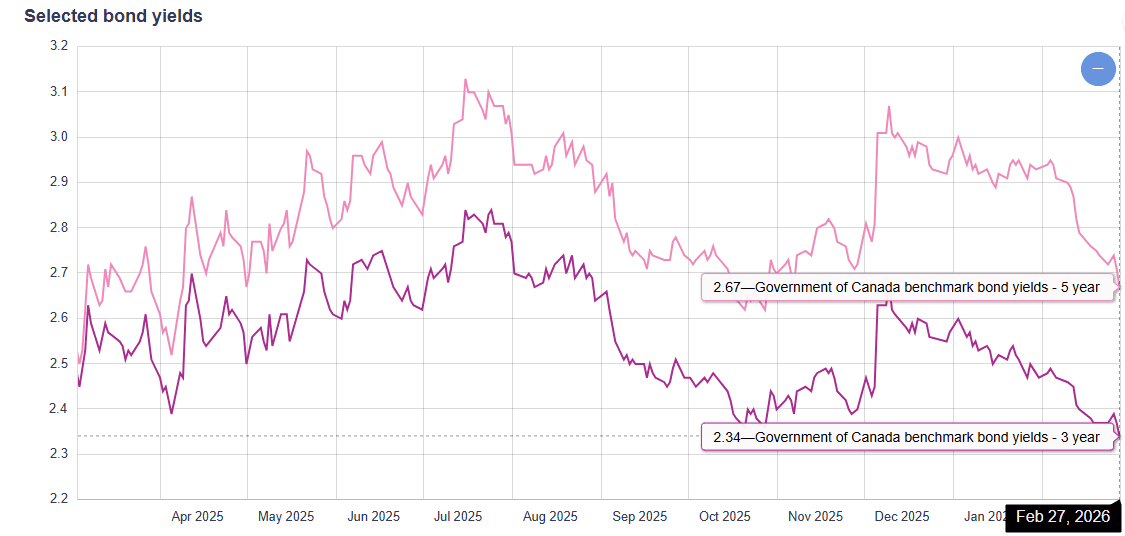
- Upcoming Bank of Canada rate announcement (March 18, 2026)
We look at some of the core factors that the Bank is monitoring to gauge which direction they are likely to go. In this case, indicators would support a hold or cut and we believe the Bank of Canada will hold rates:
- Real GDP Growth: GDP growith in Q4 of 2025 dropped to 0.7% (Source: Trading Economics). The Bank of Canada is expecting GDP growth of 1.1% in 2026, the weakest GDP growth in almost 10 years (excl 2020 due to COVID). This would support a cut. (Source: Bank of Canada)
- Inflation: Core inflation (year over year) in January was 2.6% (vs 2.8% in Dec), above the Bank’s 2% inflation target and is coming down from the high 2s. This would support a hold. (Source: Trading Economics)
- Unemployment: Decreased to 6.5% in January (0.2% lower than 1 year ago).(Source: Trading Economics). A few years ago, the CEIC estimated that Canada’s equilibrium unemployment rate is around 6.24%. Considering the values aren’t too far apart, this would justify a hold.
Home Price Prediction: Decline (apartments) and slight increase (non-apartments)
We continue to believe that non-apartment properties will experience flat or slightly upward price movements and apartment/condos prices in major markets will continue to face lower prices until excess inventory is absorbed.
- Home Prices
As a general rule of thumb, a sales to new listings ratio (SLR) above 60 is deemed a seller’s market, below 40 a buyer’s market and between the two a balanced market). In a seller’s market, prices are usually rising due to demand outstripping supply avaialble and in a buyer’s market prices are declining due to supply of new listings being greater than the demand from buyers.
Canada’s SLR dropped to 45 for the month of January from 51 in December (Source: CREA), which leaves Canada in a balanced market nationally. Months of inventory continues to trend upwards.

This is the national average and major cities are trending well below the average. For example, according to HouseSigma the Greater Toronto Area is a buyer’s market with an SLR of 19 for January. The SLR for condos is even worse (14) as we continue to see excess levels of inventory. Detached homes are faring better at 20%.
According to CREA, the National Composite MLS Home Price Index (HPI) was down month-over-month (+0.9%) and declined by 4.9% year-over-year.


 Homeowners